
Featured workflow1:30
From a printed worksheet to a written response
See one learner capture printed classroom material, listen to recognized text, speak their own answer, and return to the original worksheet.
Before: The learner has a printed Urban Heat Islands worksheet, a pencil, and Luma R1 on a desk.
After: The learner's spoken answer remains editable on screen, and the learner writes the response on the original worksheet.
Read the descriptive transcript for From a printed worksheet to a written response
0:00–0:09. The printed worksheet and device are visible together. The learner picks up the device.
Narration: “Luma R1 can help a learner work with printed classroom material while keeping the original page in the workflow.”
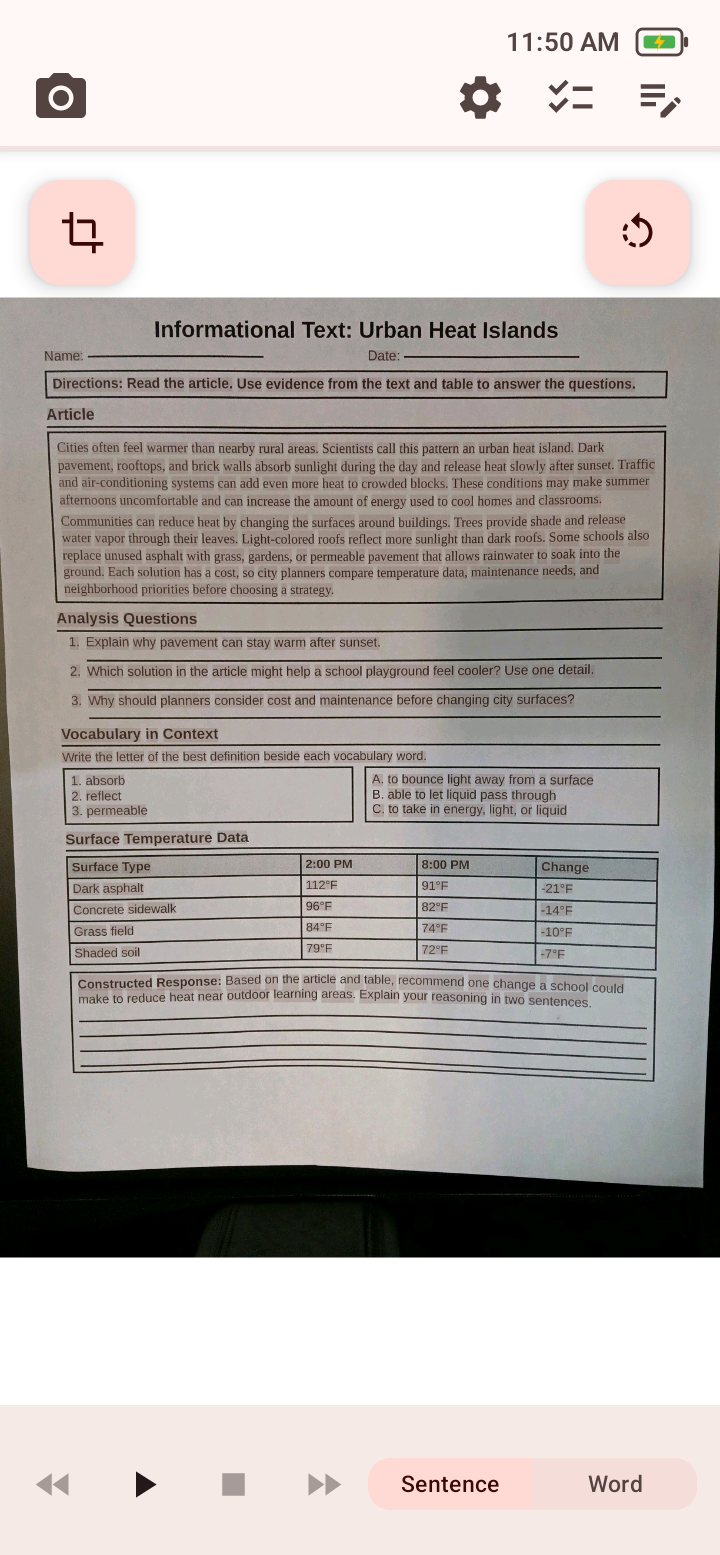
0:09–0:23. A direct screen capture shows the Manual camera view. The learner frames the worksheet and captures it. The recognized worksheet appears.
Narration: “Here, the learner captures a worksheet about urban heat islands and opens the recognized text.”
0:23–0:34. The recognized worksheet is visible with reading controls. Advanced text-to-speech highlights a segment while reading.
Narration: “Advanced text-to-speech reads the page aloud.”
Luma R1 speech: “Informational Text: Urban Heat Islands. Directions: Read the article. Use evidence from the text and table to answer the questions.”
0:35–0:49. The regular reading controls move a word highlight through the worksheet text.
Narration: “The regular reading controls can follow the text word by word as it is spoken.”
Luma R1 speech: “Communities can reduce heat by changing the surfaces around buildings. Trees provide shade and release water vapor through their leaves. Light-colored roofs reflect more sunlight than dark roofs.”
0:49–1:01. In Input Mode, the learner selects the question ‘Explain why pavement can stay warm after sunset’ and activates speech input.
Narration: “The learner selects where to respond, switches to writing, and speaks their own answer:”
1:01–1:09. The interface displays ‘Listening’ while the learner's microphone input is represented by narration rather than captured as a separate audio source.
Narration: “It absorbs heat during the day and releases it at night.”
1:09–1:15. Speech processing finishes. The response ‘It absorbs heat during the day and releases it at night’ appears below the selected question with the keyboard still available.
Narration: “The answer appears as editable text, where it can be reviewed or changed.”
1:15–1:22. The view returns to the desk. The learner holds the paper and begins writing with a pencil.
Narration: “The learner can then return to the printed worksheet and write the response on the page.”
1:23–1:30. The camera holds on the learner writing on the original worksheet beside Luma R1.
Narration: “This is one example workflow. The right tools and supports depend on the learner and the task.”